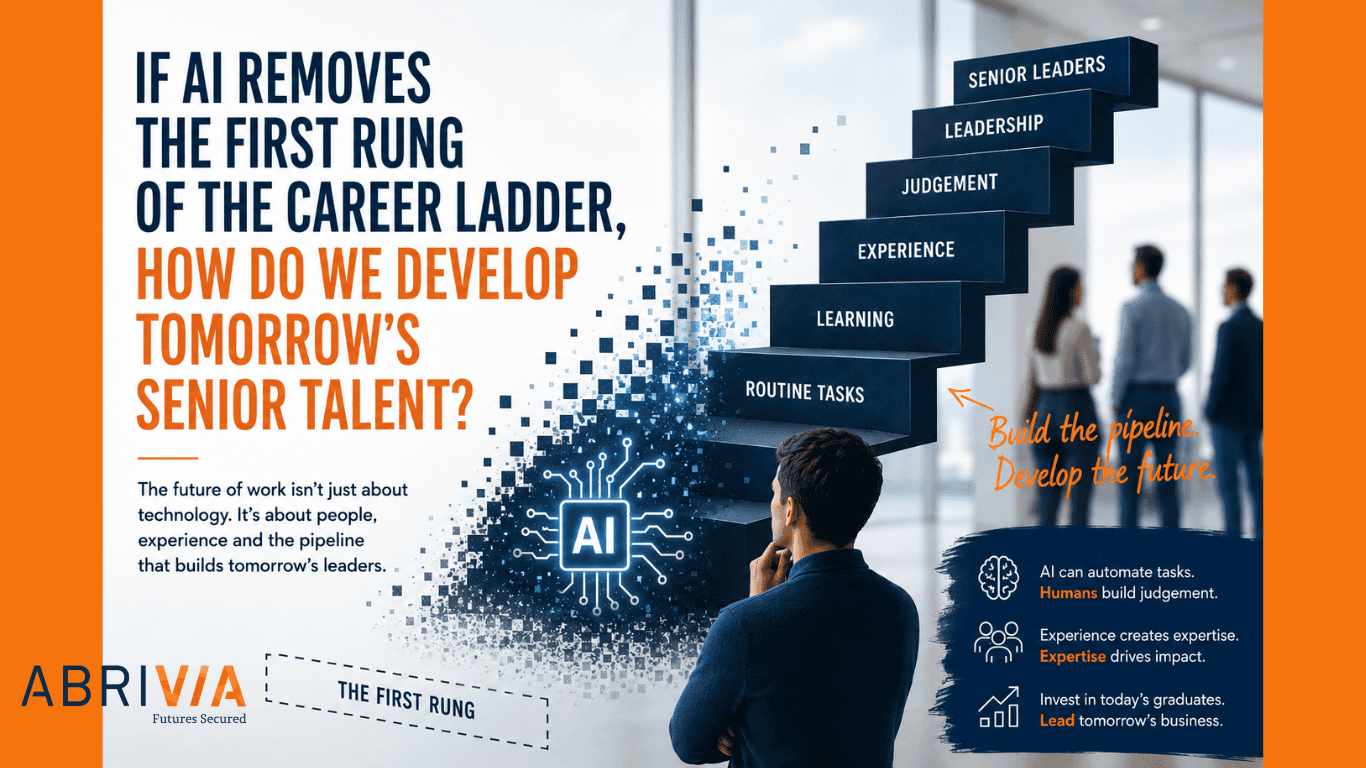
If AI Removes the First Rung of the Career Ladder, How Do We Develop Tomorrow’s Senior Talent?
One of the lessons from The Big Short is that headline numbers don’t always tell you what’s happening underneath. Sometimes the real story is sitting in the detail nobody is paying much attention to.
I think there’s a parallel with the way we’re talking about AI and jobs right now.
Most conversations have the same shape. We look at headline employment numbers, debate whether this profession or that one is “safe”, and reassure ourselves that new roles will replace old ones the way they always have.
But underneath that debate, something more immediate is happening. The skills we value are starting to change.
We’re already seeing this shift in finance. As AI and automation take on more of the technical and data-heavy work, the value of the person increasingly lies in what they do with the output. Can they interpret it, question it and recognise when it might be wrong?
The Work Nobody Misses, but Everybody Learned From
Accountancy is a good example of what’s actually at stake.
Graduates have traditionally spent a chunk of their early careers on routine work: reconciliations, testing, checking invoices, preparing schedules and drafting straightforward reports.
Nobody is arguing that work should be preserved for its own sake. But it served a purpose.
Repetition became experience. Experience became judgement. Eventually, the person doing the work became the person reviewing and challenging it.
Similar patterns exist across finance, consulting, law and many other professional services careers. The early years are often where professionals learn the fundamentals that later allow them to make sound decisions, identify risks and challenge what doesn’t look right.
What happens when technology removes part of that process?
The Seniorisation of Entry-Level Work
PwC’s 2026 AI Jobs Barometer, Two Futures for Jobs in an AI Era, offers an interesting clue.
Its research found that the most AI-exposed junior roles are seven times more likely than the least AI-exposed junior roles to require skills traditionally associated with more senior employees, including leadership and strategic thinking.
PwC describes this trend as the “seniorisation” of entry-level work.
Interestingly, these seniorised entry-level roles have grown by 35% since 2019, even as overall early-career job postings have flatlined in highly AI-exposed sectors.
As an accountancy recruiter, this is one of the most interesting developments to watch. Employers are increasingly looking for graduates and newly qualified professionals who can communicate effectively, build relationships with stakeholders, solve problems and apply commercial judgement alongside their technical accounting skills.
Those qualities have always mattered. The difference is that they are becoming more important, much earlier in someone’s career.
Nobody Actually Knows How Far This Goes
Here’s the part most advice on this topic skips.
It often treats the future shape of work as a known quantity. AI changes the entry level, humans adapt and business as usual resumes one rung up.
That might be exactly right.
It’s also possible that AI capability continues to develop well beyond today’s “very good assistant”. If it does, we aren’t just talking about entry-level jobs changing. The roles we’re currently training people to progress into may change just as fundamentally.
The honest position is that neither outcome is provable right now.
That’s not a reason to panic. It’s a reason to stop pretending we’re planning for a known future.
Why the Development Pipeline Still Matters
The real risk isn’t that AI removes certain tasks. It’s that organisations become so focused on efficiency gains that they unintentionally weaken the pipeline that develops future leaders, managers and technical experts.
If you build a genuine development pathway and the more optimistic case turns out to be right, you’ve got a stronger and more capable workforce than competitors who allowed AI to quietly hollow out their junior bench.
If the more disruptive case turns out to be right, you’ve at least built an organisation with people who know how to think, question and adapt, rather than one that’s been running on autopilot.
There’s no version of “don’t bother training people properly” that looks smart in hindsight.
For employers, the challenge is no longer simply whether to adopt AI. It’s how to embrace the efficiencies it offers without accidentally removing the experiences that develop future managers, finance leaders and partners.
AI may well change how careers begin. What remains uncertain is how organisations will develop the judgement, leadership and expertise they’ll need in the years ahead.
That’s why the talent pipeline still matters. Perhaps now more than ever.
If you would like to have a chat regarding the future of AI, looking for Hiring Insight or Career Advice, please feel free to get in touch!
If you’re looking at your hiring plans for the remainder of 2026, or finding particular roles harder to fill, speak to the team. Even if we’re not recruiting the position, we’re happy to share what we’re seeing in the market.